What can AI do for
Let's find out together. I'm Rama, an AI-native developer who builds AI into real products every day. Bring me the messy workflow, the half-working prototype, or just the question. I'll help you figure out what's worth building, and then build it with you.
AI is eating the world. I've had a front-row seat.
I've spent the past few years building with AI, not watching from the sidelines but shipping it into products real people use every day. In that short time I've seen it change shape more than once, and every shift rewrote what was possible.
It started as a clever chat box. Then it learned to read what your company knows. Now it can take a goal, work through your context with your tools, and keep going for hours without anyone holding its hand.
Each leap made AI more useful, and more demanding to do well. The gap between teams who understand that and teams who don't is getting wider every month.
- Then
Simple Q&A
You typed a question, it typed back an answer. It felt like magic, but it only knew what it was trained on, forgot everything between sessions, and couldn't touch a single one of your systems.
The lesson: Great for demos. Hard to trust with real work.
- Next
Knowledge with RAG
Teams started feeding models their own documents, tickets, and databases, so answers came from the business instead of the internet. Chatbots grew into support assistants and internal search that actually knew things.
The lesson: Retrieval became the product. Bad context in, bad answers out.
- Now
Autonomous agents
Models plan, call tools, read and write code, and work through your context step by step. With the right harness around them, they run for hours at a time and finish real tasks end to end.
The lesson: The model is rarely the bottleneck. The harness, tools, and guardrails are.
- Your turn
What will you point it at?
The capability is already here, and it keeps compounding. Waiting for AI to mature means competing with teams who started learning a year ago. Let's figure out where it fits in your work.
Explore it with me
Most teams don't need another chatbot. They need AI that does real work.
Every company is being told to adopt AI. Very few are told how. The distance between a slick demo and something your team relies on every day is where most AI projects stall: outputs nobody trusts, no way to measure quality, and no connection to the systems that actually run the business.
That gap is where I work. I design the harnesses, integrations, and workflows that make models dependable, and I build them alongside your team so the knowledge stays in-house when I leave.
Sound familiar?
- Your team repeats the same pattern of work for hours every week.
- You have an AI prototype that nobody trusts in production.
- Your engineers want to build with AI but lack the tooling and practices.
- You know AI matters, but not where to start.
Where I can help
Four ways to work together. Most engagements start with one and grow into the others.
Harness engineering
The scaffolding that turns a capable model into a reliable system.
- Agent loops and tool design
- Sandboxed code execution
- Evals and regression tests
- Cost and latency tuning
AI integration
LLMs wired into the product your customers already use.
- Retrieval over your docs and data
- Structured outputs and validation
- Streaming, chat, and copilot UX
- Routing across model providers
Agentic workflows
Agents that take real actions, with a human in the loop where it matters.
- MCP servers for internal tools
- Multi-step automations
- Review and approval flows
- Observability and audit trails
AI adoption
Getting your engineering team to work AI-native, for good.
- Claude Code and Codex setup
- Workshops and pairing sessions
- Internal AI tooling
- Guidelines that actually stick
How we'd work together
No big-bang transformation. We start small, prove value on real work, and grow from there.
- 1
Explore
A conversation about your team, your data, and the work that eats your week. We leave with a short list of places where AI clearly pays off.
- 2
Prototype
A working prototype on your real data, not a slide deck. You see what the model does well and where it breaks before you commit.
- 3
Ship
Production hardening: evals, guardrails, monitoring, and integration with the systems you already run.
- 4
Hand over
Docs, training, and pairing so your team can own it, extend it, and build the next one without me.
I build with AI every day, not just talk about it.
Hype is cheap. I've spent the last few years shipping AI to real users, and I'll give you an honest read on what works, what doesn't, and what's worth your money.
Agents in production
I've built AI agents for helpdesk and teammate products, moved an agent stack from LangChain to custom tooling, and validated a sandboxed Claude Code harness.
Open-source AI tooling
I maintain open-source adapters, including a Vercel AI SDK provider for IBM watsonx and a WhatsApp adapter for the Chat SDK.
Full stack, end to end
TypeScript, Python, PHP, Go, and Swift. I can build the model layer, the API, and the interface people actually touch.
Product-minded
Apple Developer Academy alumnus and Swift Student Challenge finalist. I care whether the thing is good to use, not only whether it runs.
Things I've built
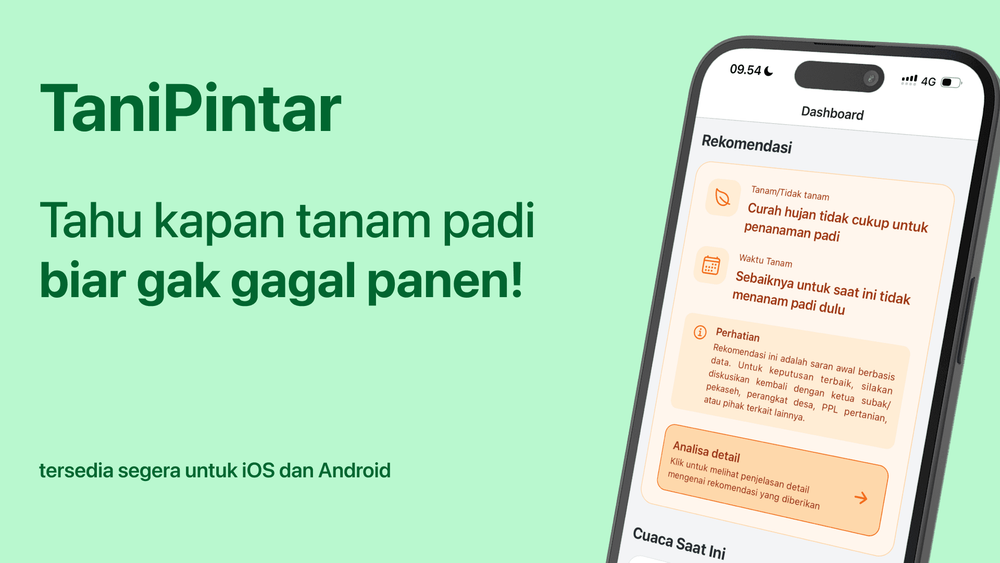
Tani Pintar
A climate-focused mobile app for Indonesian rice farmers.
Chat Adapter for Baileys
WhatsApp adapter for the Chat SDK
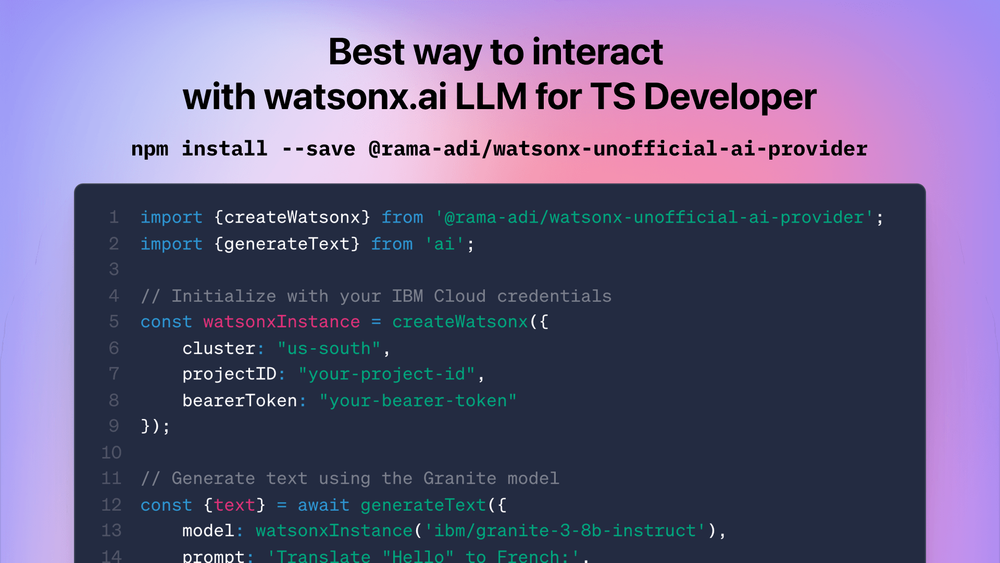
Watsonx AI SDK adapter (Unofficial)
Vercel AI SDK v5 Adapter for IBM Watsonx
Questions you might have
We don't know where to start with AI.
That's the most common starting point, and a good one. The first conversation is about your work, not the technology. We'll find one workflow where AI clearly pays off and start there.
Will it work with our existing stack?
Almost certainly. I work across TypeScript, Python, PHP and Laravel, Go, and Swift, and with Anthropic, OpenAI, Google, and open-source models. AI should fit into what you already run, not replace it.
Can you work with our in-house engineers?
That's the best setup. I can lead a build, pair with your team, or review and unblock AI work you've already started.
Is a small project worth reaching out about?
Yes. Some of the most valuable AI work is small: one automation, one internal tool, one well-built integration. Send it over and we'll see.
Notes from building
Shipping in public
Most of my work happens on GitHub. Here's the last year of it.
So, what could AI do for your business?
Let's explore it together. Tell me about your team and the work that slows it down. You'll get an honest take on what AI can and can't do for it, and a clear next step.